
Born to Run
In “The Wind”, Lauren Groff repurposes the American road trip myth to show us how far we still have to go
Is it fast enough so we can fly away? Over highways jammed with broken heroes?
In suicide machines, on a last chance power drive?
In at least two of their greatest songs, Tracy and Bruce tapped into the one American myth that still carries astonishing vigor. Like other perceptive American writers and lyricists, they understood, in their bones, that America remains as disconnected as ever from its storied past. The story of America—or, more accurately, the competing stories of America, depending on whether it’s told by someone who is subjugated, a subduer, or someone who fits both roles—has never truly taken root, found sustenance, or found its footing.
But how can they, when they clash and contradict each other at every turn? The land of the free is now moonlighting as the carceral state. The home of the brave is too afraid of what mishigas might break out if its people were allowed to control or protect their own bodies. And the cult of the rugged individual has long since replaced its frontier chapel of nonconformity and individualism with a gilded cathedral of privatization, making it nearly impossible for the inner lives of Americans to ever feel truly connected to a shared American dream, if such a dream could ever be found.
Yet one myth persists, out in the open, in America. We are born to run. We are restlessly searching for whatever nourishment remains within our disconnected selves, whether we’re slurping from straws dipped in mass media or in algorithmically determined slush and slop. We’ll jump into any nearby fast car that will take us to belonging, even if it’s a mirage. It’s the road trip as baptism, renewal through heading elsewhere—anywhere except where arriving happens, because arrival looks a lot like stillness, and that would break the spell. Perpetual motion is what will save us, or at least occupy us for a little longer, or, at the very least, distract us from ever measuring how empty our lives have become or how far we still have to go to find what we truly need to fix ourselves.
Recently, I’ve become enamored with the stories of fiction writer Lauren Groff. I first learned about her while revisiting a collection of Flannery O’Connor’s short stories. Groff wrote the introduction, in which she deftly balanced glowing admiration for O’Connor’s craftsmanship as a prose writer and storyteller with an honest acknowledgment of the biases O’Connor brought to her work. While killing time at the Center for Fiction in downtown Brooklyn, waiting for my phone to be fixed, I came across Groff’s new short-story collection, Brawler. I opened the book to the first story and read the first sentence.
Pretend, the mother had said when she crept to her daughter’s room in the night, that tomorrow is just an ordinary day.
I knew immediately I didn’t need to read another word before heading to the counter to buy it. Less than a week later, I had read all nine of its stories.
While I’m tempted to write a full review, many others, who are better writers and better-read than I, have already done so. I will nevertheless share a brief, tidy TLDR on Brawler as a whole: it’s a monumental collection of short stories that evokes the storytelling heft and truth-telling power you’d find in collections like Flannery O’Connor’s A Good Man Is Hard To Find and Other Stories or J.D. Salinger’s Nine Stories. In fact, Groff’s characters in Brawler will remind you of many of Salinger’s and O’Connor’s broken, searching characters.
For example, the coming-of-age story of the rich kid Chip in “What’s The Time, Mr. Wolf”—the longest story in this collection and arguably its centerpiece—evokes the tragic, self-loathing arc of Holden Caulfield in Catcher in the Rye. Groff, however, is less charitable to Chip than Salinger is to Holden, stretching Chip’s loneliness over a longer span and across multiple stages of his life, and resolving his story more bitterly. Along the way, she showcases one of her most effective tools as a writer: her ability to seamlessly shift the narrative gaze, moving from Chip’s perspective to that of the object of his yearning, Pearl Spang, thereby revealing alternative truths too uncomfortable for the protagonist’s own eyes. (Groff also uses this device so effectively in her novel Fates and Furies.)
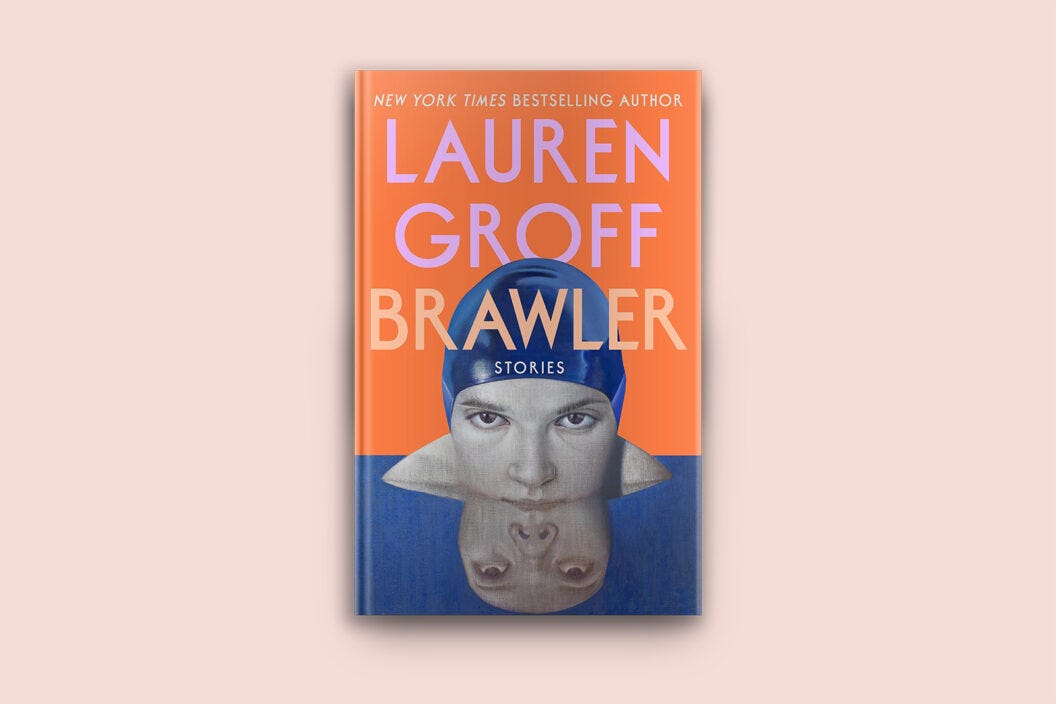
However, one story from Brawler, “The Wind,” has lingered with me since I first read its opening sentence in the bookstore. Originally published in The New Yorker in 2021, it must have been finished by Groff as she and those around her were grappling with the new, disconcerting, and isolating dynamics of the COVID-19 pandemic. It was a time when we, as Americans, were getting in our cars and taking road trips—to the beach, upstate from the city, cross-country, or just driving around our neighborhoods—doing anything to break up the overly ordinary days we felt stuck in while confined by social distancing and obligatory mask-wearing. This interplay of the ordinary and the extraordinary, the private and the public, was—just like coronavirus—in the wind, and Groff, like all of us, was breathing it. Lucky for us, she exhaled one of the most haunting and devastatingly edifying American road-trip stories ever written.
The story begins with 12-year-old Michelle leading her younger brothers, Ralphie and Joey, ages 9 and 6, away from their home, “so far in the country, the bus came for them first.” Following instructions their mother confided to Michelle in the middle of the night, the three children get off the bus before it reaches their school so they can rendezvous with their mother, Mama, who is waiting for them in her old Dodge. They make a pit stop at her workplace to pick up her paycheck, then they’re on the road to Albany to catch a bus to a city that is never named. Mid-journey, Mama assuages her three children, saying there are “museums and parks and movie theaters and subways and everything,” where “there’ll be no more stupid sheep to take care of and it’ll be safe. No more having to run out to the barn to sleep,” and where there is “a life that will be so boring, every day it will be the same, and it is going to be wonderful. OK?”
There is a sinister breeze blowing throughout the story, like the big bad wolf that is always stalking the piggies and the sheep, often lingering right outside the gates or behind the wall, sometimes breaking through, breaking ribs, bruising skin, smashing teeth, but always living inside the minds of its intended victims. It’s a tension that never resolves because it stems from an affliction so ugly and cruel that it becomes embedded so deeply in Mama and her children that it will be passed down for generations. It’s the other myth of America that has persisted, not out in the open but in its darkest corners and beneath its floorboards.
To emphasize this lasting impact of violence, Groff chose a narrator who is neither Mama nor her oldest child, Michelle, but Michelle’s daughter. In this way, Michelle becomes the fulcrum of the tale, and her trauma, from witnessing what happens to Mama at their home to experiencing the same brutality when she puts her body in front of Mama to defend her, transforms the twelve-year-old. She becomes the parent not only to her younger brothers but also to Mama. She’s now the beating heart of the family as they hit the road in hopes of reinventing their lives. Below, the narrator, Michelle’s daughter, recounts what her mother told her about that moment many decades ago, when Michelle became aware of the gravity of her newfound responsibility.
And then [Mama] started breathing crazily, and leaned forward until her forehead rested on the wheel, and the car stopped in the middle of the road. The wind howled around it.
Mama, we need to drive, my mother said. We need to drive now. We need to go. …
It’s OK, it’s OK, it’s OK, my grandmother whispered. It’s just that my body is not really listening to me. I can’t move anything right now. I can’t move my feet. Oh, god.
It’s fine, my mother said softly. Don’t worry. You’re fine. You can take the time you need to calm down.
And at this moment my mother [Michelle] saw with terrible clarity that everything depended upon her. The knowledge was heavy on the nape of her neck, like a hand pressing down hard.
This heavy weight, “like a hand pressing down hard,” is something renowned psychologist Alice Miller wrote extensively about in The Drama of the Gifted Child, her 1979 bestseller. According to Miller, early-life trauma often leads a child to adopt survival strategies that rely on repression and the self-denial of one’s own needs. One such strategy is for the child to reverse roles and become the parent. But in doing so, the child no longer has the capacity to focus on their own needs or to experience a normal childhood, much like the trade-off the body makes by entering a coma to conserve as much energy as possible to fight off a harrowing infection. This child grows up without learning how to fully feel1. They remain disconnected from themselves and others and, unless there is some course correction or intervention, they eventually lead an empty, depressed life as an adult.
Throughout their lives, these parentified children withdraw from others (for safety’s sake!), becoming far more cautious and self-oriented, even perfectionistic. This personal privatization not only closes off their inner lives but also means those who develop this self-protection mechanism can’t help but pass it down to their own children. It’s a ripple effect we don’t talk about enough, and it’s one of the quieter ways the legacy of violence endures across generations. Groff’s narrator in “The Wind” captures this dynamic so poignantly when she describes how her mother Michelle’s experiences affect her own life:
But always inside my mother there would blow a silent wind, a wind that died and gusted again, raging throughout her life, touching every moment she lived after this one. She tried her best, but she couldn’t help filling me with this same wind. It seeped into me through her blood, through every bite of food she made for me, through every night she waited, shaking with fear, for me to come home by curfew, through every scolding, everything she forbade me to say or think or do or be, through all the ways she taught me to move as a woman in the world.
In her author’s note at the end of her collection, Groff shares that “this story lived in my body before I even had language, passed down from my mother and my mother’s mother. It was brought to the surface by a terrifying conversation with a stranger…” In a similar way, especially for me and the many others who can identify at least a little with what Michelle went through, the unassailable power of “The Wind” lies in its ability to dredge up the reasons we learned to be indifferent, why we “dark forest” ourselves away from the forces we fear can harm us, and why we view connection and openness as vices and as jeopardizing.
Groff, to be clear, is shining a spotlight on what women have gone through, not just in America and in modern times, but in all parts of the world and throughout history. She is writing about “this wind” in women that is “passed down from a time beyond history…that is dark and ceaseless and raging within”. As a society, we are a very long way from sharing evenly the burden and pain of the consequences of generational violence. As a man, I can see that if I am part of this story, I may be both a victim and an assailant. And there are, of course, other axes of unevenness. Non-whites, non-heterosexuals, and disabled people have also been disproportionately exposed to the damage and worst outcomes of violence. Whether Groff intended it or not, her story here is not just about the wind blowing inside women but about what is blowing inside everyone.
And given how, in America, systems of violence and domination perpetuate the closing off of our personal lives, our disconnection from one another, and the overwhelming sense that safety is not evenly available, the very idea of a “melting pot of America” can now be seen for what it is, a ruse. Groff, together with other American creatives—such as songwriters Bruce Springsteen and Tracy Chapman, writers John Steinbeck, Jack Kerouac, and Toni Morrison, and new American writers looking at America through an immigrant’s eyes, such as Elaine Castillo and Carlos Bulosan—also see this. They understand that to confront the very idea of America, you have to repurpose its myths or, at the very least, see clearly how they feed off one another. We are born to run, hit the road, get in a fast car, strive to be baptized (again and again), or do whatever it takes to move toward a blank slate or fresh start—all ways of forgetting who we are or where we come from—because we don’t yet have the fortitude to honestly reckon with the uglier story of America that resides in its darkest corners or beneath its floorboards. Or, for some, like the protagonists of “The Wind,” the circumstances are so dire that there is no choice but to move as far away from the wolf as possible, as quickly as possible.
Mama, Michelle, Ralphie, and Joey’s story has been living in my head for weeks now. I suspect it will stay with me much longer, rattling around, never settling. I am very thankful for some of the decisions Groff made in her storytelling, for example, never naming the wolf and matter-of-factly showing us, the readers, that the silence or inaction of others in their community is also an important part of the story. And although I truly wish otherwise, as I meditate on this story that won’t leave me, I keep coming to the same somber conclusion. Nothing will change, and we will continue to struggle to find a shared and safe story of America unless we publicly acknowledge and reckon with the horrible truth we, as Americans, work so hard to keep hidden and private. That we have not measured up to America’s promise—a promise that is impossible to keep because it was not written by us or for us and never honestly reflected how we want to see ourselves. That, as Americans, we have, for some time, felt deeply inadequate, rootless, desperate, and lonely as a result. And that, to compensate and make ourselves feel whole again, we have done terrible and violent things to one another. ☀
“But I have always been struck, in America, by an emotional poverty so bottomless, and a terror of human life, of human touch, so deep, that virtually no American appears able to achieve any viable, organic connection between his public stance and his private life. This is what makes them so baffling, so moving, so exasperating, and so untrustworthy. “Only connect,” Henry James has said. Perhaps only an American writer would have been driven to say it, his very existence being so threatened by the failure, in most American lives, of the most elementary and crucial connections.”
—James Baldwin, No Name in The Street
In The Drama of The Gifted Child, in section “The Disturbance” (p. 34), Alice Miller discusses what may occur when a child represses their own needs to take care of their parent:
“What happens if a mother not only is unable to recognize and fulfill her child’s needs, but is herself in need of assurance? Quite unconsciously, the mother then tries to assuage her own needs through her child. This does not rule out strong affection; the mother often loves her child passionately, but not in the way he needs to be loved. The reliability, continuity, and constancy that are so important for the child are therefore missing from this exploitative relationship. What is missing above all is the framework within which the child could experience his feelings and emotions. Instead, he develops something the mother needs, and although this certainly saves his life (by securing the mother’s or the father’s “love”) at the time, it may nevertheless prevent him, throughout his life, from being himself.
In such cases the natural needs appropriate to the child’s age cannot be integrated, so they are repressed or split off. This person will later live in the past without realizing it and will continue to react to past dangers as if they were present.”
Britain is defined by so much history dating back to an age that Americans find mind blowing. So the facts versus fiction is less defined for me. Funnily enough I think of America as much more swathed in myth, partly I suppose due to a feeling of rootlessness and also a need to try and establish a common identity
Darius, what a wonderful essay on a subject of such universality that its roots lie in all of humanity. However the American view of generational violence does feel more at home in a country whose past is swathed in myth and, to some extent, fantasy.